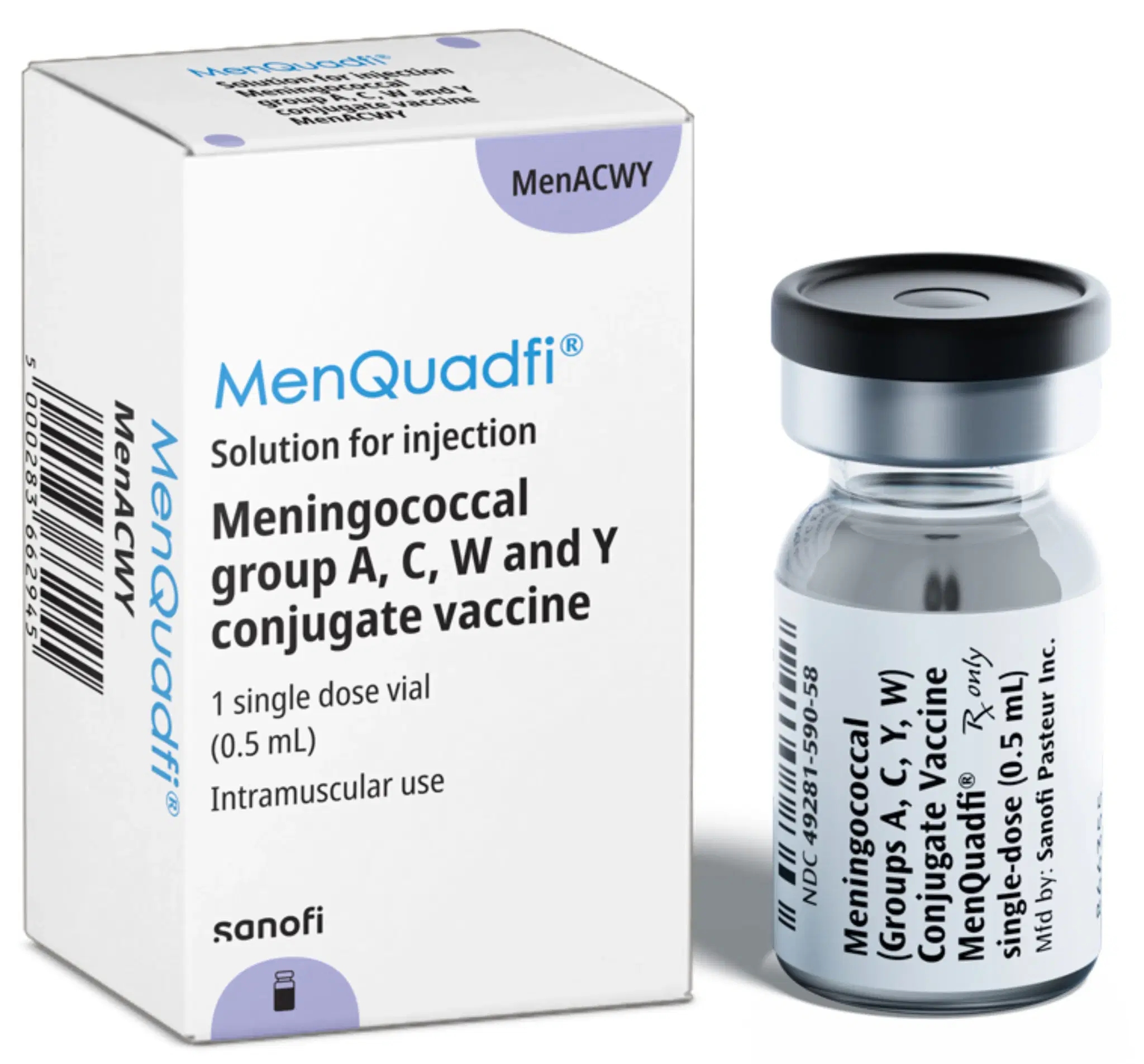
MenQuadfi
Meningococcal Group A, C, W and Y conjugate vaccine containing Neisseria meningitidis group A, C, W and Y polysaccharides conjugated to tetanus toxoid
MenQuadfi is a MenACWY conjugate vaccine used in the UK to help protect people aged 12 months and over against invasive meningococcal disease caused by Neisseria meningitidis serogroups A, C, W and Y. It is a fully liquid, ready-to-use vaccine with no reconstitution required, which can simplify handling in practice. MenQuadfi is given as a single 0.5 mL intramuscular dose and may also be used as a booster in people who have previously received a meningococcal vaccine covering the same serogroups. UK official sources place MenACWY vaccination within routine adolescent immunisation, catch-up vaccination, selected risk groups and certain outbreak or contact settings. Clinical studies assessed immune responses across toddlers, children, adolescents, adults and older adults, with strong bactericidal antibody responses measured 30 days after vaccination. MenQuadfi should be used in line with official recommendations and full prescribing information, and it does not protect against meningococcal serogroup B or infections caused by other bacteria or viruses.
| Dosage | Price |
|---|---|
| 0.5 mL | £40 |
Product Details
Active Ingredient
Meningococcal Group A, C, W and Y conjugate vaccine containing Neisseria meningitidis group A, C, W and Y polysaccharides conjugated to tetanus toxoid
Brand
Sanofi
Drug Class
Meningococcal conjugate vaccine, ATC code J07AH08
Administration
Intramuscular injection, preferably in the deltoid region or anterolateral thigh depending on age and muscle mass
Prescription Status
Prescription Only Medicine (POM)
Dosage Form
Solution for injection in a single-dose vial
Strengths Available
One single 0.5 mL dose containing 10 micrograms each of serogroups A, C, W and Y polysaccharides conjugated to 55 micrograms tetanus toxoid carrier protein
How MenQuadfi Works
Mechanism of Action
Product Manual- MenQuadfi stimulates the immune system to produce bactericidal antibodies against the capsular polysaccharides of Neisseria meningitidis serogroups A, C, W and Y.
- These anti-capsular antibodies help protect against invasive meningococcal disease through complement mediated bactericidal activity.
- Because the polysaccharides are conjugated to tetanus toxoid, the vaccine is designed to generate a stronger and more durable immune response than plain polysaccharide vaccination.
Key Actions
- It helps the body recognise meningococcal serogroups A, C, W and Y before exposure, so immune defences can respond faster.
- It supports protection against serious invasive disease, including meningitis and septicaemia caused by the covered serogroups.
- Its ready-to-use liquid formulation avoids reconstitution and can make vaccine preparation more straightforward in clinical settings.
Clinical Effectiveness
Average Weight Loss
MenQuadfi showed strong immunogenicity rather than weight-loss outcomes. In adults aged 18 to 55 years in study MET43, day-30 hSBA seroprotection rates were 93.5 percent for serogroup A, 93.5 percent for C, 94.5 percent for W and 98.6 percent for Y. In toddlers 12 to 23 months in study MEQ00065, hSBA seroprotection against serogroup C reached 99.5 percent and rSBA seroprotection reached 100 percent 30 days after vaccination.
MenQuadfi is a vaccine, so clinical effectiveness is described by immunogenicity and seroprotection endpoints. Across pivotal studies, immune responses were assessed 30 days after a single dose, with antibody persistence data available from at least 3 years and up to 7 years after primary vaccination.
Key Clinical Trials
MEQ00065
Duration & Size
Day-30 immunogenicity study in meningococcal vaccine-naive toddlers aged 12 through 23 months; MenQuadfi analyses included about 214 subjects for hSBA and 213 for rSBA serogroup C endpoints
Highest Avg Weight Loss
Serogroup C hSBA seroprotection was 99.5 percent and rSBA seroprotection was 100 percent at day 30 after a single dose
Common Side Effects
Irritability, Injection site tenderness or pain, Drowsiness
Key Takeaway
MenQuadfi showed superiority versus MenACWY-TT for hSBA seroprotection and hSBA and rSBA GMTs for serogroup C, while maintaining non-inferiority for key seroprotection endpoints.
MET35
Duration & Size
Day-30 immunogenicity study in children aged 2 through 9 years, stratified by ages 2 through 5 and 6 through 9; MenQuadfi groups included roughly 227 to 229 children in each age stratum depending on serogroup endpoint
Highest Avg Weight Loss
In children aged 6 through 9 years, day-30 hSBA seroprotection reached 99.1 percent for serogroup Y and 98.7 percent for serogroup W
Common Side Effects
Injection site pain, Headache, Myalgia
Key Takeaway
MenQuadfi met immune non-inferiority criteria versus MenACWY-CRM for all four serogroups in children aged 2 through 9 years.
MET43
Duration & Size
Day-30 immunogenicity study in adults aged 18 through 55 years; MenQuadfi analyses included about 1,406 to 1,410 adults depending on serogroup endpoint
Highest Avg Weight Loss
Day-30 hSBA seroprotection was 93.5 percent for serogroups A and C, 94.5 percent for W and 98.6 percent for Y
Common Side Effects
Injection site pain, Myalgia, Malaise
Key Takeaway
MenQuadfi demonstrated non-inferior immune responses versus MenACWY-DT and produced higher GMTs than the comparator across all four serogroups in this adult study.
MET49
Duration & Size
Day-30 immunogenicity study in adults aged 56 years and older; MenQuadfi analyses included 433 adults for each serogroup endpoint
Highest Avg Weight Loss
Day-30 hSBA seroprotection was 89.4 percent for A, 90.1 percent for C, 77.4 percent for W and 91.7 percent for Y
Common Side Effects
Injection site pain, Myalgia, Headache
Key Takeaway
MenQuadfi achieved non-inferior immune responses versus quadrivalent meningococcal polysaccharide vaccine in older adults and showed higher GMTs across the four serogroups.
Dosing Information
MenQuadfi is given as a single intramuscular 0.5 mL dose for primary immunisation in people aged 12 months and over. It may also be used as a booster for people previously vaccinated against the same meningococcal serogroups.
| Weeks | Dose | Frequency |
|---|---|---|
| Single visit | 0.5 mL | One intramuscular dose |
| Booster when clinically indicated | 0.5 mL | Single booster dose |
Important: There are no data to indicate the routine need for, or timing of, a MenQuadfi booster dose. Long-term antibody persistence data are available up to 7 years after vaccination. MenQuadfi should not be administered subcutaneously, intravascularly or intradermally.
Additional Information
Onset of Action
Protective immune responses were assessed 30 days after vaccination in the pivotal studies. In routine UK practice, first-time university entrants under 25 are advised to receive MenACWY ideally at least 2 weeks before starting university, which gives a practical guide to timing before risk of exposure.
Manufacturer
MenQuadfi is marketed in the UK by Aventis Pharma Limited trading as Sanofi, Reading, Berkshire. The UK prescribing information lists PLGB 04425/0878, with the SmPC revised on 15 January 2026. EU product information also identifies Sanofi Winthrop Industrie as the marketing authorisation holder.
Eligibility & Access
Private Prescription
For travel-only indications, MenACWY vaccination is generally arranged through a private travel immunisation service. UKHSA routine PGD documents state that MenACWY vaccine is not available on the NHS solely for the purpose of travel.
NHS Access
On the NHS, MenACWY vaccination is offered routinely to teenagers, usually in school year 9 or 10, with catch-up for people up to their 25th birthday if vaccination history is incomplete or unknown. It is also used for some close contacts of confirmed cases, selected outbreak responses and people at increased risk because of certain medical conditions under specific PGDs.
Rollout Information
Current UK materials describe MenACWY access through routine adolescent vaccination, catch-up, risk-group and outbreak or contact pathways rather than a phased commercial rollout.
Injection Sites
abdomen
The abdomen is not a recommended site for MenQuadfi. The vaccine should be given intramuscularly, preferably in the deltoid region or anterolateral thigh.
upperArm
Preferred site for many older children, adolescents and adults, using the deltoid muscle.
thigh
Anterolateral thigh is an appropriate intramuscular site depending on the recipient's age and muscle mass, especially in younger children.
Side Effects & Safety
Common Side Effects
In clinical trials, the most frequently reported reactions within 7 days after MenQuadfi alone in toddlers aged 12 through 23 months were irritability at 36.7 percent and injection site tenderness at 30.6 percent. In people aged 2 years and above, the most frequent reactions were injection site pain at 38.7 percent and myalgia at 30.5 percent. In toddlers, very common reactions also included appetite lost, drowsiness, abnormal crying, injection site erythema and swelling. In older children and adults, headache, malaise and injection site redness or swelling were also reported. Most reported reactions were mild or moderate.
- •Injection site pain or tenderness
- •Myalgia
- •Headache
- •Malaise
- •Fever
- •Irritability in toddlers
Serious Side Effects
Serious side effects are extremely rare, but it is important to know the signs so you can get help if you need it.
ⓘAnaphylaxis
Very rare but potentially life-threatening allergic reactions can occur after vaccination. Urgent medical help is needed if symptoms such as difficulty breathing, swelling of the face or throat, or collapse occur.
ⓘHypersensitivity
Post-marketing reports include hypersensitivity reactions. MenQuadfi is contraindicated in people with hypersensitivity to the active substances, excipients, or a previous dose of this vaccine or a vaccine containing the same components.
ⓘSeizures or febrile convulsions
These are listed as not known in post-marketing data. Any suspected seizure, significant collapse episode or fever-related convulsion after vaccination should be assessed promptly.
Injection Site Reactions
Injection site pain is very common in people aged 2 years and above. In toddlers, tenderness or pain, erythema and swelling are very common. Uncommon reactions can include pruritus, induration, bruising, warmth or rash at the injection site depending on age group.
How to Manage Side Effects
- ✓Advise patients or carers that local pain, redness, swelling and mild systemic symptoms can occur in the first week after vaccination and are usually self-limiting.
- ✓Seek urgent medical attention if there are signs of a severe allergic reaction such as breathing difficulty or facial or throat swelling.
- ✓Vaccination should be postponed in acute severe febrile illness, and appropriate facilities for management of anaphylaxis should always be available where the vaccine is given.
How Long Do Side Effects Last?
Solicited adverse reactions were reported within 7 days after vaccination and were mostly mild or moderate in intensity.
Long-Term Safety
Available studies show antibody persistence data from at least 3 years up to 7 years after primary vaccination. Booster-dose safety in adolescents and adults was comparable to the primary-dose safety profile seen in those age groups.
What Happens If I Lose Weight Too Quickly?
Not applicable. MenQuadfi is a vaccine and is not used for weight loss.
Storage & Travel
Storage Instructions
Store in a refrigerator at 2 degrees Celsius to 8 degrees Celsius. Do not freeze. Stability data show the vaccine components are stable at temperatures up to 25 degrees Celsius for 72 hours, after which the vaccine should be used or discarded. This temporary excursion guidance is intended for healthcare professionals.
Travel Guidelines
For travel-related vaccination, MenACWY is usually accessed through a private travel service rather than the NHS. The product should remain within cold-chain requirements, although temporary temperature excursion data up to 25 degrees Celsius for 72 hours may support professional handling decisions during storage or transport incidents.
Diet & Lifestyle
Lifestyle Considerations
- No special diet is required with MenQuadfi.
- Vaccination does not replace standard infection prevention advice for people at increased risk or travelling to high-risk settings.
- For settings such as university entry or planned travel, vaccination should be arranged early enough to allow time before exposure.
Muscle Mass Consideration
Risk: Because MenQuadfi must be given intramuscularly, the chosen injection site should match the recipient's age and muscle mass. Incorrect site selection can make administration less appropriate or less comfortable.
Advice: Use the deltoid in many older children and adults, and the anterolateral thigh when muscle bulk or age makes that preferable. MenQuadfi should not be given subcutaneously, intravascularly or intradermally.
Benefits of Weight Loss
- Helps provide active protection against invasive meningococcal disease caused by serogroups A, C, W and Y
- Supports prevention of serious outcomes such as meningitis and septicaemia caused by covered serogroups
- Offers broad quadrivalent coverage in one vaccine
- Can be used in routine adolescent programmes, catch-up pathways and selected risk-based indications
- Ready-to-use liquid formulation avoids reconstitution before administration
Comparison with Alternatives
| Product | Active Ingredient | Mechanism | Dose | Weight Loss Potential |
|---|---|---|---|---|
| Menveo | Meningococcal Group A, C, W-135 and Y conjugate vaccine | Quadrivalent meningococcal conjugate vaccine that stimulates antibodies against serogroups A, C, W-135 and Y | Single intramuscular injection; EMA overview describes Menveo as licensed from 2 years of age and supplied as powder and solution that are mixed before injection | Not applicable to vaccines. EMA states Menveo was as effective as its comparator in stimulating immune response against all four covered serogroups in adults and children from 2 years of age |
| Nimenrix | Meningococcal groups A, C, W-135 and Y conjugate vaccine | Quadrivalent meningococcal conjugate vaccine using polysaccharides conjugated to tetanus toxoid | Given intramuscularly; EMA overview describes Nimenrix as licensed from 6 weeks of age and supplied as powder plus solvent for reconstitution | Not applicable to vaccines. EMA states a single injection in people aged 1 year and older was as effective as comparator vaccines in stimulating immune response against all four serogroups |
Note: All three products are MenACWY conjugate vaccines used according to official recommendations. MenQuadfi stands out for its ready-to-use liquid formulation, Nimenrix covers younger infants, and Menveo is another established quadrivalent option. Product choice should take age, indication, local protocol and supply into account.
Frequently Asked Questions
Common questions about the product. If you have more questions, please contact our support team or book a consultation with one of our clinicians.
Important Disclaimer
MenQuadfi is a prescription vaccine that should be supplied and administered by qualified healthcare professionals in line with the UK SmPC and official recommendations. This information is not a substitute for clinical judgement, immunisation guidance or the full prescribing information. Suitability depends on age, indication, vaccination history, allergy status, current illness and risk factors. MenQuadfi does not protect against meningococcal serogroup B or all causes of meningitis or septicaemia.
References
Sanofi Campus UK MenQuadfi product page
UK product summary and support information for healthcare professionals
https://pro.campus.sanofi/uk/products/menquadfiMenQuadfi UK Prescribing Information PDF
UK prescribing information including legal category, dosage, contraindications and adverse reactions
https://pro.campus.sanofi/dam/jcr%3A8e9c1745-d4cd-4c78-a226-f934d2da127e/MenQuadfi-PI-UK.pdfMenQuadfi SmPC
Current UK summary of product characteristics
https://www.medicines.org.uk/emc/product/12818/smpcMenQuadfi patient leaflet PDF
Patient leaflet with administration, safety and practical information
https://www.medicines.org.uk/emc/files/pil.12818.pdfMenQuadfi EPAR
European Medicines Agency overview and product information
https://www.ema.europa.eu/en/medicines/human/EPAR/menquadfiNHS MenACWY vaccine information
NHS guidance on eligibility, access and administration of MenACWY vaccination in the UK
https://www.nhs.uk/vaccinations/menacwy-vaccine/UKHSA MenACWY routine PGD template
Routine programme PGD including eligibility, exclusions and NHS availability boundaries
https://www.england.nhs.uk/north-east-yorkshire/wp-content/uploads/sites/49/2025/06/Menveo-Nimenrix-MenQuadfi.pdfUKHSA MenACWY risk groups PGD template
Risk-group PGD for people at increased risk of invasive meningococcal disease
https://www.england.nhs.uk/north-east-yorkshire/wp-content/uploads/sites/49/2025/06/Menveo-Nimenrix-MenQuadfi-for-risk-groups.pdfThe information on this page is based on the sources listed above. Always consult with a qualified healthcare professional for medical advice.